Good news for Arrowtown’s biodiversity: less possums, more birds?
Date: 4th February 2026
Arrowtown and the surrounding Coronet Face area are seeing encouraging signs for local biodiversity, thanks to ongoing work between Whakatipu Wildlife Trust and Southern Lakes Sanctuary – and an army of volunteers and supporters.
Since this work began, over 4,500 possums have been caught, and anecdotally locals are reporting more native bird life – trends that upcoming biodiversity monitoring should hopefully confirm.
Arrowtown’s possum population is shrinking – even as our trap network grows
Since 2022, the Arrowtown AT220/520 trap network has expanded from 28 to 117 traps, dramatically increasing coverage across the basin edge. Despite this growth, the average number of possums caught per trap has fallen steadily – a classic sign of mature suppression. While total possums removed continue to rise, the decline in per-trap catches shows that possum densities are genuinely dropping, giving native birds and trees a much-needed reprieve.
Arrowtown key numbers
Year | Number of traps | Total possums caught | Avg possums per AT trap |
2022 | 28 | 431 | 15.4 |
2023 | 47 | 549 | 11.6 |
2024 | 47 | 540 | 11.5 |
2025 | 117 | 1078 | 9.2 |

Southern Lakes Sanctuary’s Whakatipu Coordinator, Bonnie Wilkins, reluring possum traps
Coronet Face: rapid knockdown to sustained control
Coronet Face, a newer project spanning steep slopes and a diverse mix of tussockland, regenerating beech pockets, exotic woodlands and native plantings, has seen fast-moving results. Initial possum knockdowns were high, but in just two years the area has transitioned into sustained suppression, demonstrating the impact of coordinated predator control across complex and challenging terrain.
Coronet Face key numbers
Year | Number of traps | Total possums caught | Avg possums per AT trap |
2023 | 27 | 381 | 14.1 |
2024 | 41 | 777 | 18.9 |
2025 | 42 | 450 | 10.7 |
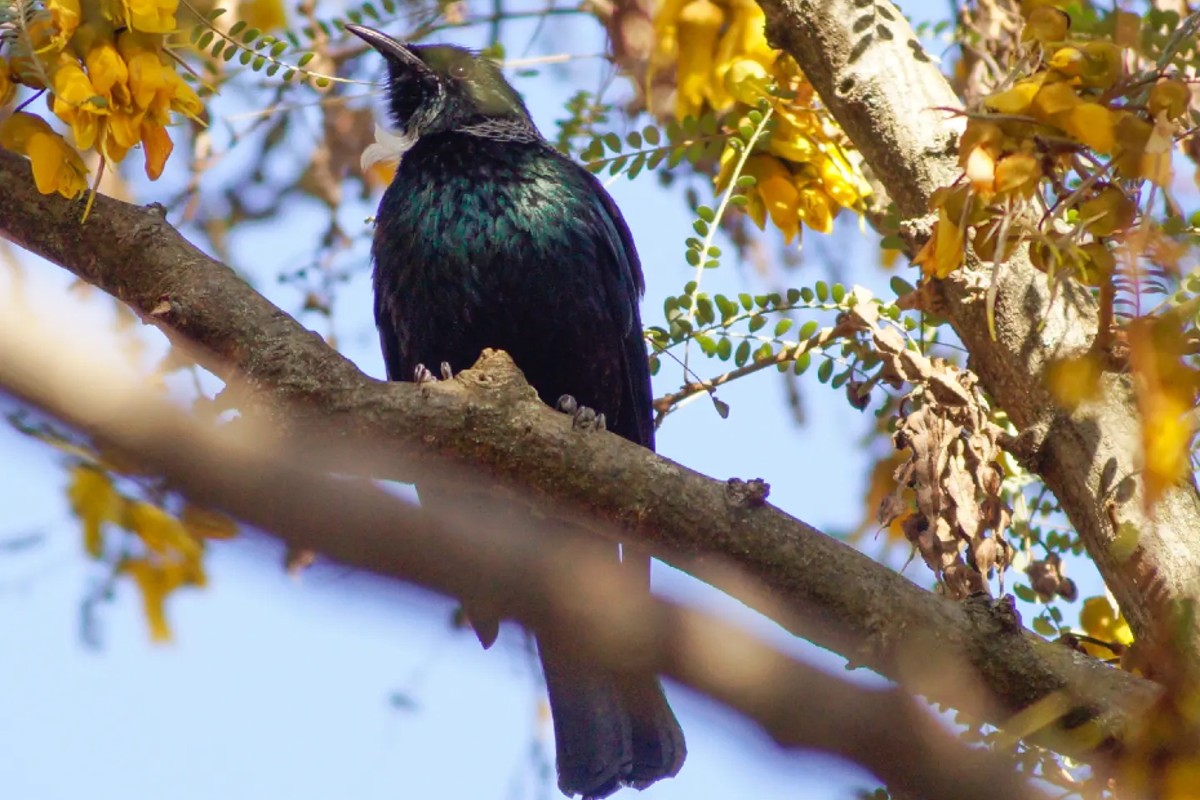
Tūī © Ben Carson
Whakatipu Wildlife Trust are about to commence bird monitoring which we hope will confirm this and Southern Lakes Sanctuary has recently installed acoustic monitoring devices to support this.
“Our data show a clear shift from knockdown into suppression,” says Paul Kavanagh, Chief Executive of Southern Lakes Sanctuary. “These results – fewer possums, more resilient birdlife, recovering forests – are only possible because of sustained effort across the community. Ongoing biodiversity monitoring is essential to measure that progress – and it’s an area where further support from local businesses can make a real difference.”
Heatmaps showing possum waxtag results

From our highest initial measure in April 2023

To our most recent measure in October 2025.
As well as the waxtag results, the camera results are also showing a reduction in possums, with the latest October measure seeing the lowest number of possums since beginning the camera monitoring. Although there was a spike in May 2025, this seems to have been caused by a few individuals learning to access the mayonnaise lure and returning each night, rather than an actual increase in the possum population.

A community effort
These results are made possible through a broad and committed community effort. Alongside the core partnership between Whakatipu Wildlife Trust and Southern Lakes Sanctuary supported by dozens of volunteers, groups like Predator Free Arrowtown, Coronet Face Trapping Group, Te Tapu o Tāne, NZSki, Soho Property Ltd and Treespace are all actively trapping across the landscape
This work is further strengthened by generous financial support from The Hills, the late Sir Michael Hill and his family, Rod Drury/TRAC and QLDC. Southern Lakes Sanctuary has provided specialist knowledge and coordination to integrate trapping and monitoring at a landscape scale.
This momentum also complements the significant mahi of other landholders and community groups. Soho Property Ltd has continued its extensive animal pest control programme across the Mahu Whenua Covenants, removing 2,344 goats and 156 pigs in 2025. In partnership with QLDC, they worked to clear the hill behind the Coronet Forest block, eliminating a further 289 goats from council land in two targeted shoots.
Community groups are also delivering long-term gains for biodiversity. Arrowtown Choppers and volunteers have helped clear around 100 hectares of wilding pines (in addition to the sustained work by Wakatipu Wilding Control Group and Soho Property Ltd), while large-scale native planting is rebuilding habitat across the catchment.
Arrowtown Choppers have led the planting of more than 35,000 native plants, including 29,000 along the Sawpit Gully Track and over 6,000 trees in Bush Creek, planted with the help of Arrowtown School and local Scouts. Whakatipu Reforestation Trust have also planted more than 4,000 native plants around Bush Creek near the Chinese Village. Together, this work is restoring forest structure and creating habitat that will support even more abundant native birdlife over time.

Arrowtown Choppers planting day, Sawpit Gully
Anna Harding-Shaw, Executive Director of Whakatipu Wildlife Trust, says: “This is exactly the kind of outcome we hope for when communities, volunteers, landowners and conservation organisations work together. Hearing locals tell us they’re seeing more native birds in the area shows the real, positive impact of sustained predator control.”
The outcome: safer habitats for native birds, healthier forests and a visible shift toward ecological recovery.
Keen to get involved? Visit
https://whakatipuwildlifetrust.org.nz/ or https://arrowtownchoppers.co.nz/
Posted in: Home Page, News and stories